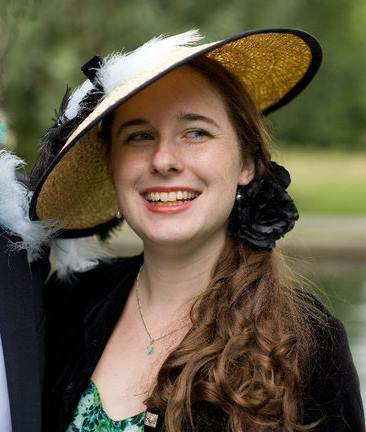





I was privileged to be asked to lead a course for young people on behalf of the charity ‘The Muslin Trust’ hosted by the London College of Fashion. My aim was to guide the students in creating period accurate muslin Regency gowns. The project was created to showcase muslin fabric traditionally hand woven in Bangladesh in order to support and promote the artisan weavers.
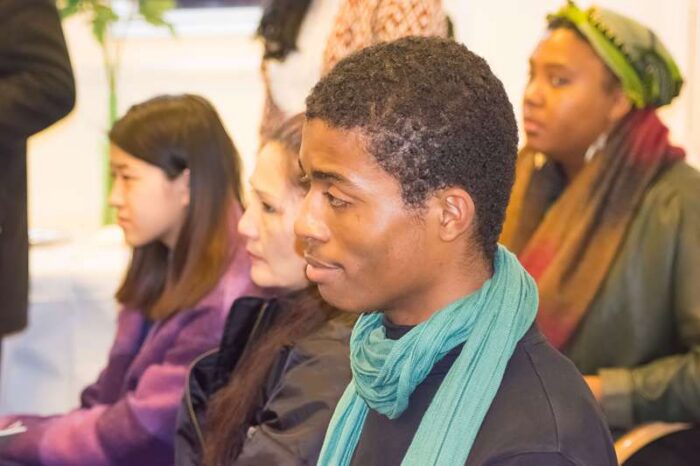
The group of 16-18 year old students were drawn from the local community (East London) so they brought a wide range of different backgrounds and cultures to the table. I led ten weekend course sessions with the group where they learnt about the history of muslin fabric and it’s production. We also covered hand sewing techniques and the history of fashion in Europe with period construction and design.
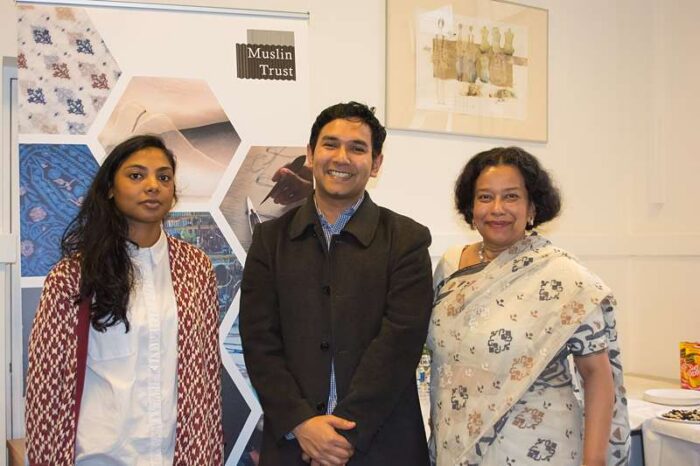
I was wonderfully supported by Rifat Wihhab who organises the The Muslin Trust charity alongside other committee members and staff at the London College of Fashion.
Alongside me I had fellow tutors Elizabeth Callow and Eleanor Parr-Bell. I recruited both of them after having been hired myself, knowing it would be better to share my fee and bring extra knowledge, skills and an ability to be with more than one student at a time to the sessions. Eleanor and I studied on the same university course, Costume Design at Wimbledon School of Art. And I met Elizabeth Callow on the Amateur Dramatics circuit where she a is a provider of costumes from her large store to many productions in the Surrey and South East area.
See the official full write up of the project here:
The Jamdani project: A journey of intergenerational and transnational learning
Dr Lipi Begum, Subject Leader in Fashion Marketing and Branding, London College of Fashion
Why and how The Jamdani project was created
The project was organised by The Muslin Trust and the Outreach Team at the London College of Fashion with funding from Awards for All and Big Lottery Fund England. The skills needed to create the unique Jamdani fabrics could be become endangered if the fabrics are not bought, distributed and used. The Jamdani project aimed to provide a commission to the artisan weavers in Bangladesh and a connection to it’s end use as European fashion. By using the Jamdani cloth to make garments, the young people in London on the course can learnt about the geography, history and social importance of these fabrics both now and in the past.
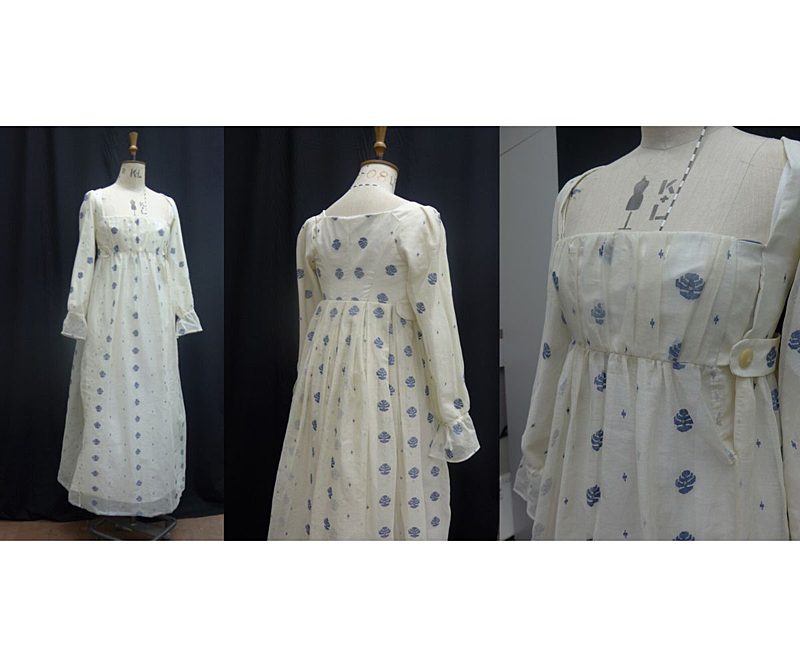
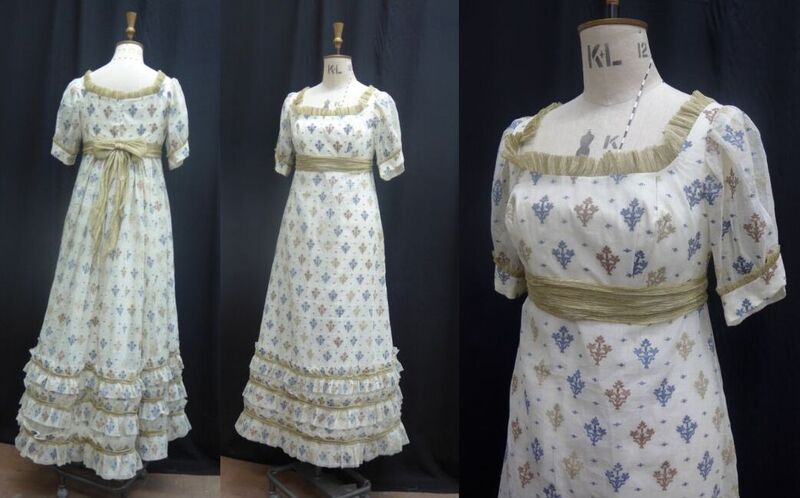
The Finished Muslin Regency Dresses
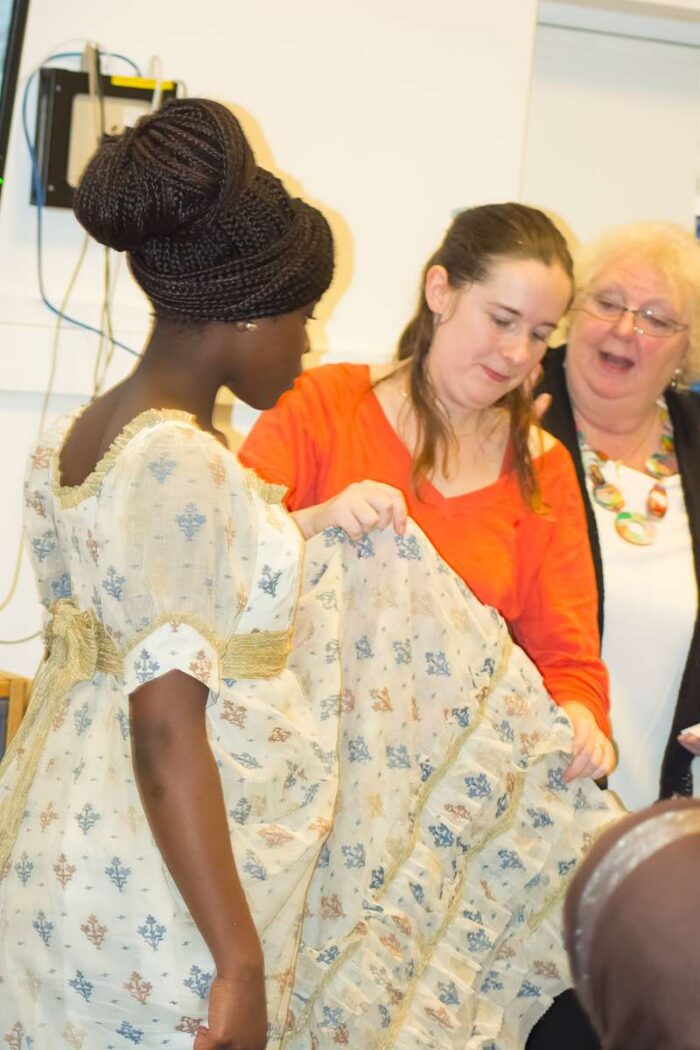
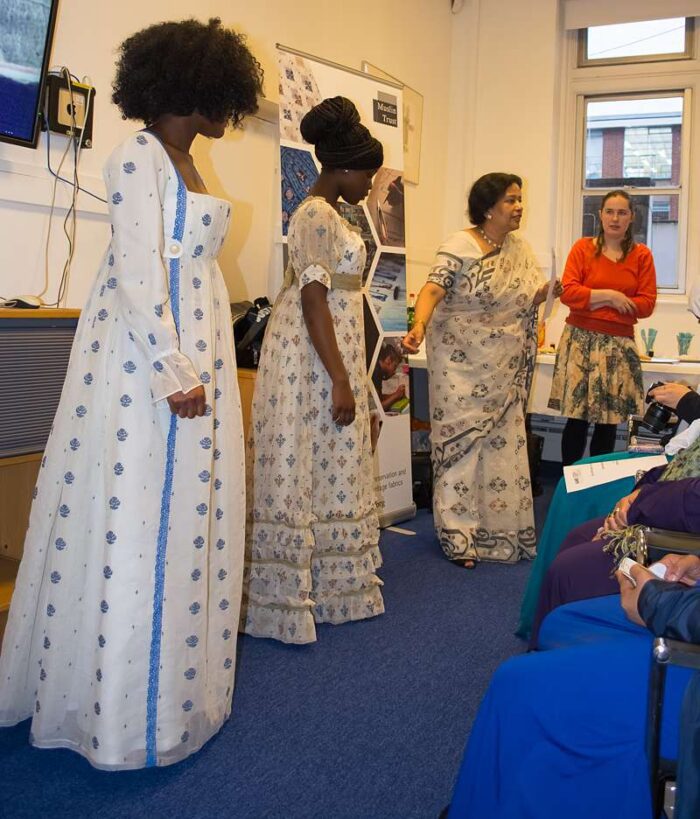
The finished dresses were shown to the parents and supporters of the students and project at a reception held in November 2015. Two of our students modelled the gowns for everyone to see how they looked in action. The project also gained coverage in the local press (in Hackney Today and East End Life). The dresses were shown to the public again in February 2016, at the Muslin Festival hosted by the National Museum of Dhaka in Bangladesh.
Each dress was entirely hand stitched using period accurate pattern cutting and sewing techniques. The students undertook all the sewing work under guidance. We also made boned petticoats, a chemisette and a bum-roll to support the period shape and use of the two gowns.
What is Jamdani?
Jamdani is a weaving technique used with fine cotton fibres fabrics to create high end luxurious muslin fabrics. Muslin a a very sheer, soft floating fabric and historically it is famous for being the popular fabric of choice for women’s clothing in Euproe during the Regency Era (or Napoleonic in France). Cottons fibres were so finely woven that the fabric was said to be ‘woven from air’. High waisted dresses, know as ‘Empire line’ styles are most fmailiar to the general public in modern day via the famous novels by Jane Austen. You can see these dress styles still produced as costumes for TV and film adaptantions of the stories. On of my favouite examples is ‘Sense and Sensibility‘ with award winning costumes by Jenny Beavan.
Production of the Jamdani Fabric
Two full length Jamdani fabrics were specially commissioned and created by traditional artisan weavers in the village of Rupshi in Dhaka. They were then imported to the UK ready for the students to inspect and use.
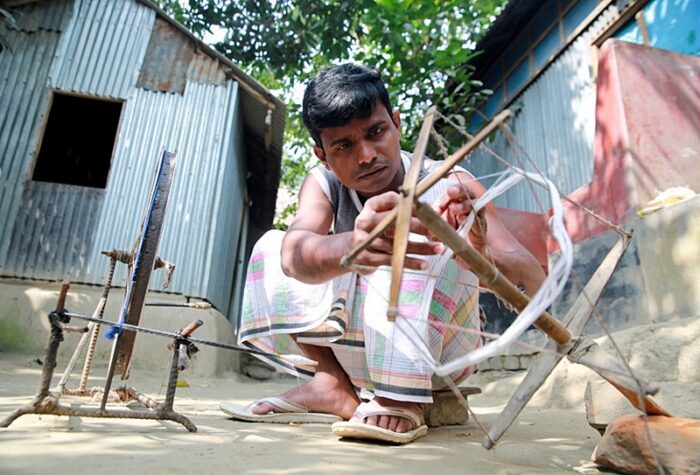
Jabbar, Master-weaver in Rupshi which is a village known for Jamdani (Dhaka, Bangladesh). Jabbar’s skills were passed down to him through previous generations. He uses a bamboo splinter in place of a needle to combine techniques of weaving, embroidery and ornamentation.
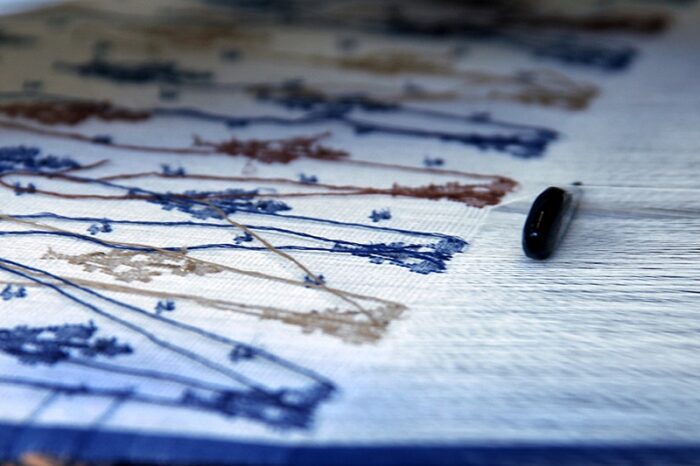
Close up of the Jamdani cloth’s pattern being produced on the handloom. The coloured threads are dyed using natural indigo. Motifs are sewn into the cloth using the regular holes between the warp and the weft. These traditional Jamdanis are usually patterned in soft shades of fine grey cotton, with blue-grey or cream-white coloured designs. The most common patterns are flowers in bhutidar-style (set all over) or tircha (run diagonally) (Bhatnagar).
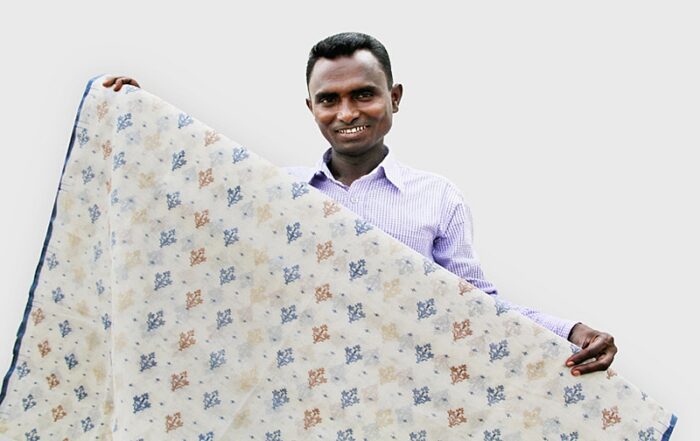
Jabbar, our master-weaver shows one of the finished fabrics. This one has been decorated in the bhutidar style, a Puratan Bhuti (ancient print) pattern.
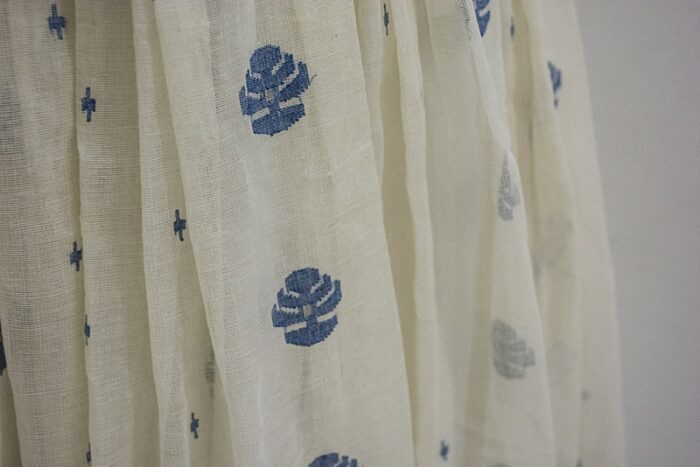
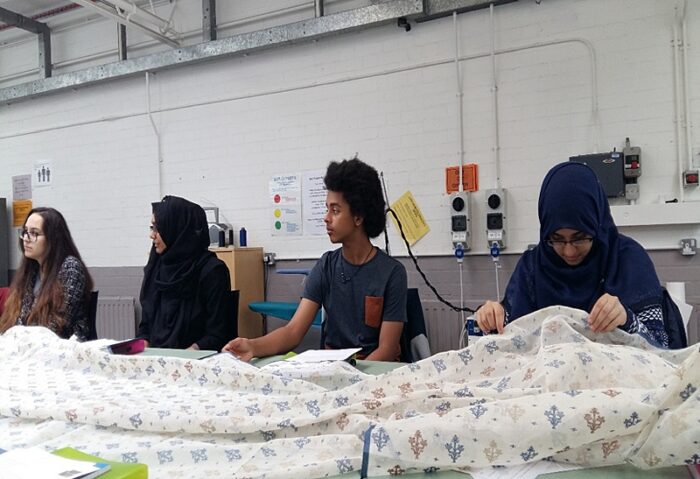
Once the fabrics arrived in London the students were able to examine them in detail. The left Jamdani cloth has a simple blue Bhager Phara (tiger’s footprint), the other a Puratan Bhuti (ancient print) design in three colours.
Teaching Fashion History at London College of Fashion 2015
The 10 week course was taught by three tutors, Felicity Westmacott, Eleanor Parr-Bell and Elizabeth Callow.
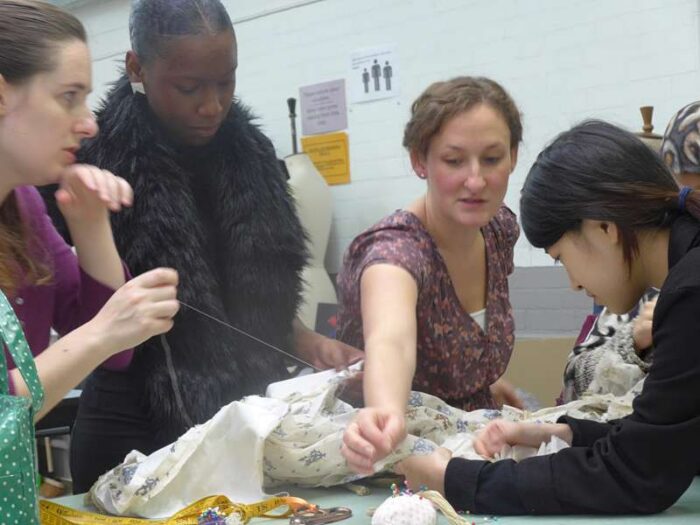
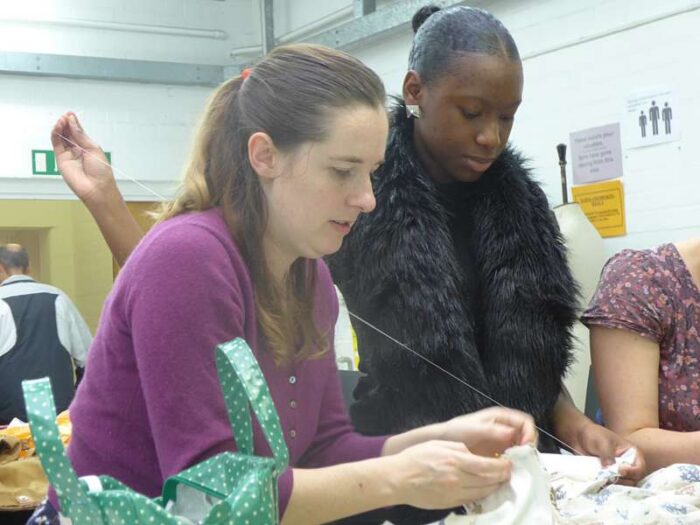
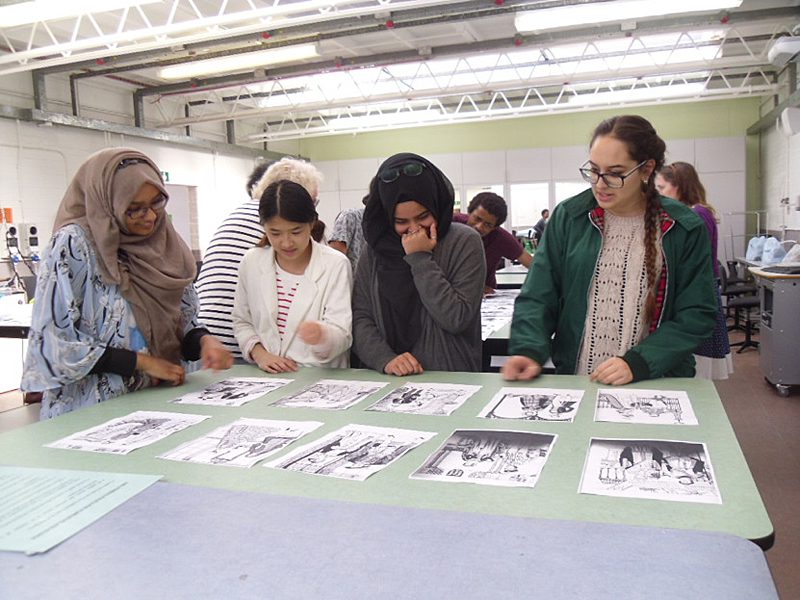
Students learning about Western fashion history, in order to understand the context in which the Regency Empire-line styles developed.
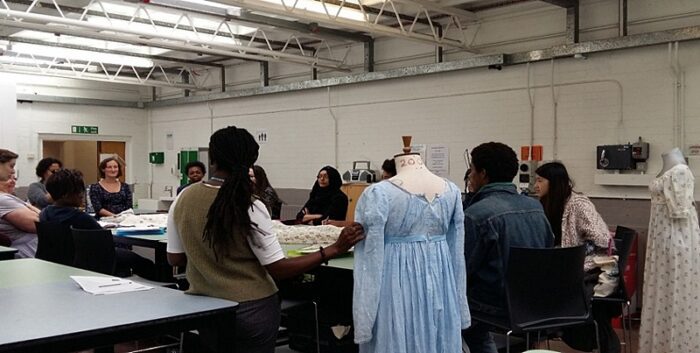
The course took place at the Mare street campus of London College of fashion Students and tutors at the LCF studios in Mare Street. In one of the first sessions we borrowed two previous reproduction Jan Austen style dresses for the students to see and touch. The garments had been created as part of a project run by the Brick Lane Circle and Stepney Trust entitled ‘How villages and towns in Bengal dressed London ladies in the 17th, 18th and early 19th centuries’ (2013).
The students were taught various hand stitching techniques including, running stitch, back stitch and slip stitch. As a tutor I guided them in learning about boning channels, how to sew on fastenings like buttons and hooks and ‘knotted bars’ for the closures.
Dress Designs
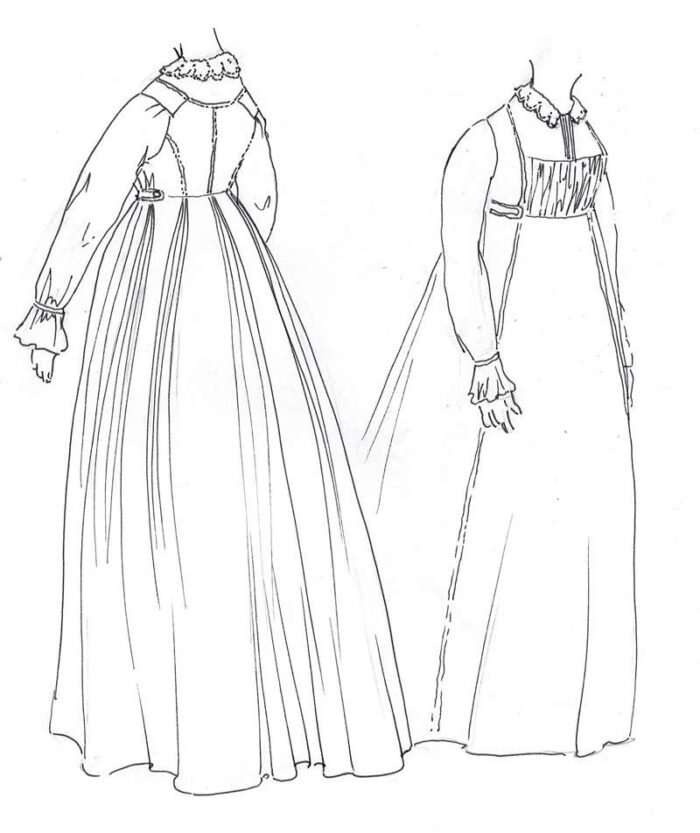
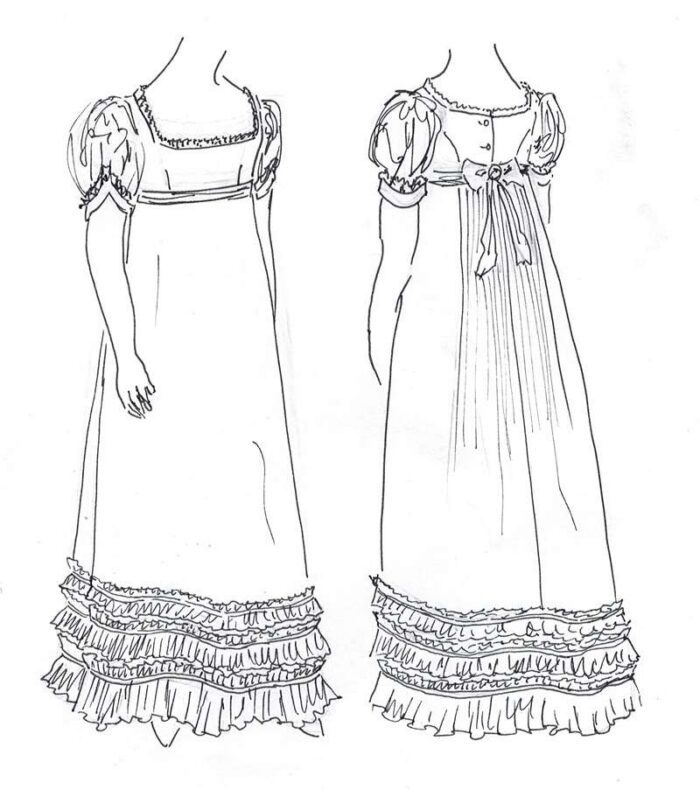
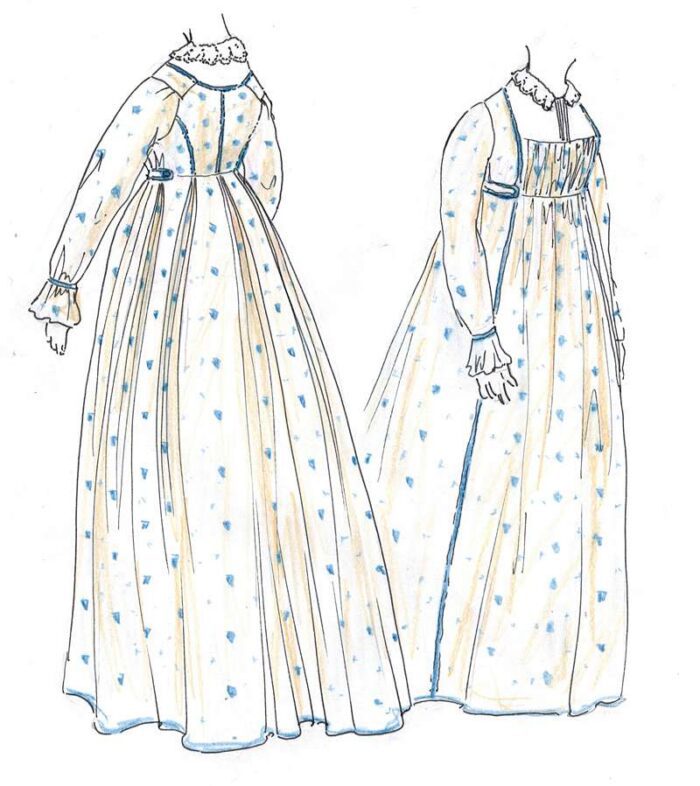
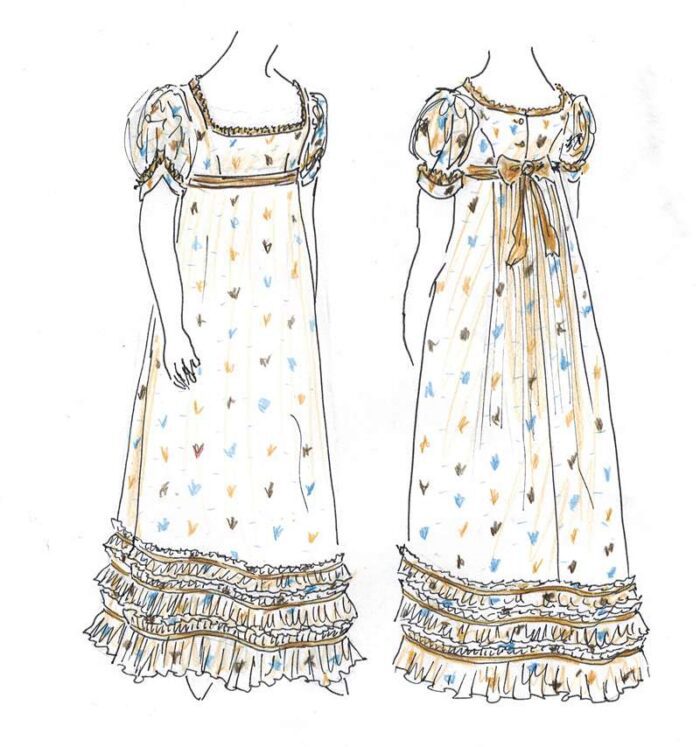
Here are line, and colour designs for the two dress styles we created on the course. I designed both dresses based on historical research. The first dress is a ‘Day Dress’ from about 1800 with quite a full skirt and box pleats at the back. The second dress is an evening dress design from a slightly later date of about 1815. The skirt shape is narrower and the waistline higher.
Details of the hand made Regency dresses
The Muslin Day Dress 1800


The day dress had a front fastening bodice. The students mastered a ‘knotted stitch’ technique to create thread loops for the metal hooks.
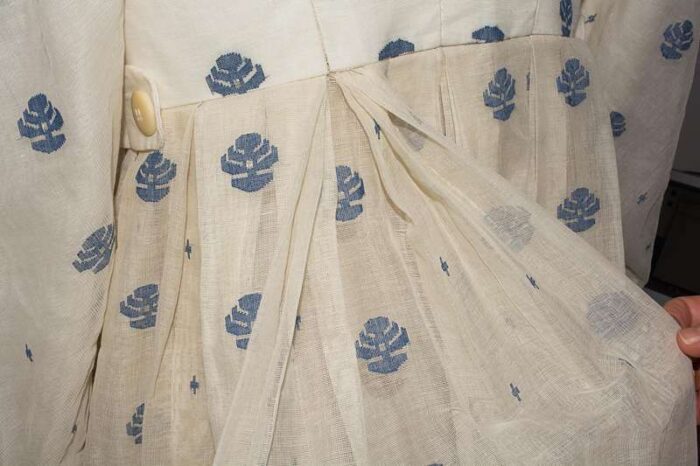
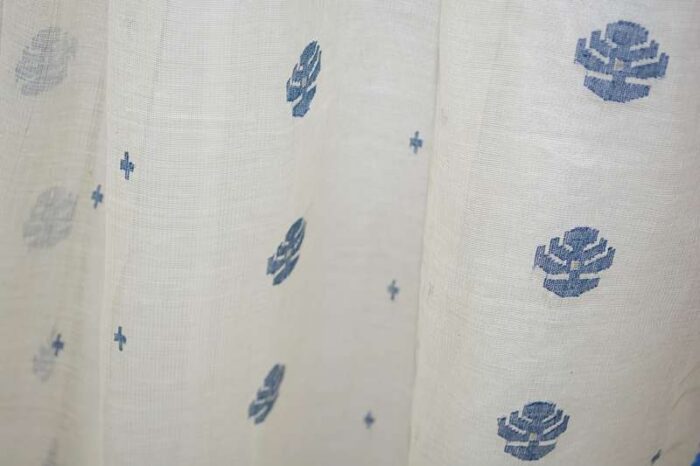
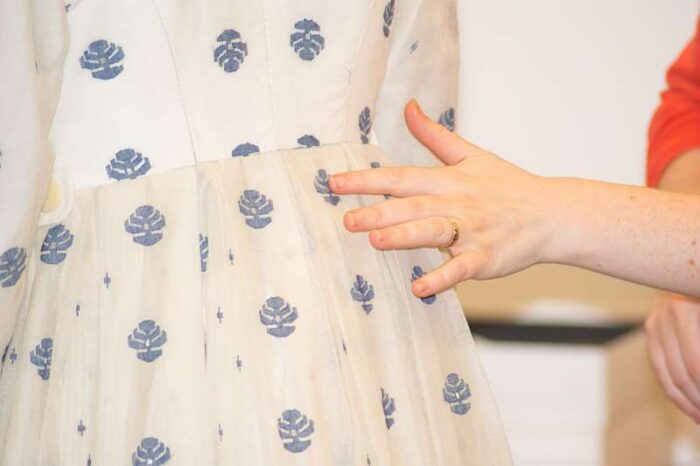
Fullness in the skirt of the day dress was pleated into the back waistline with triple layer box pleats. We lined up the pattern of the fabric carefully to ensure the blue ‘tiger’s feet’ were featured down the middle of both inner and outer pleats.
A mistake was made when cutting out the day dress back bodice panels. The tiger’s foot pattern on this area is the wrong way up compared to the rest of the dress. You can also see the characteristic ‘narrow back’ cut of this era in fashion history with the low shoulder and curved back seams.
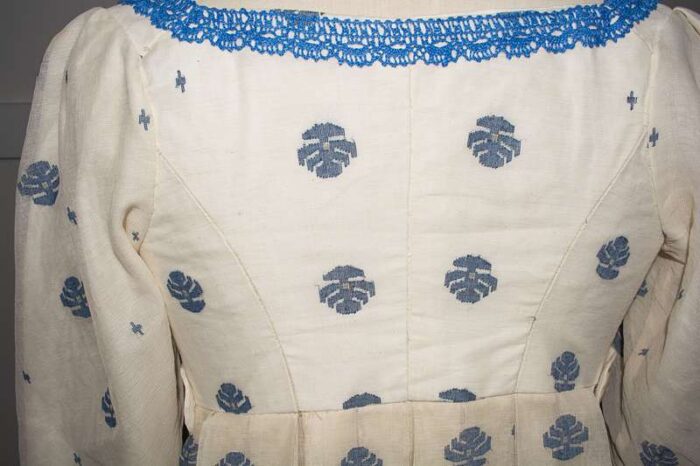
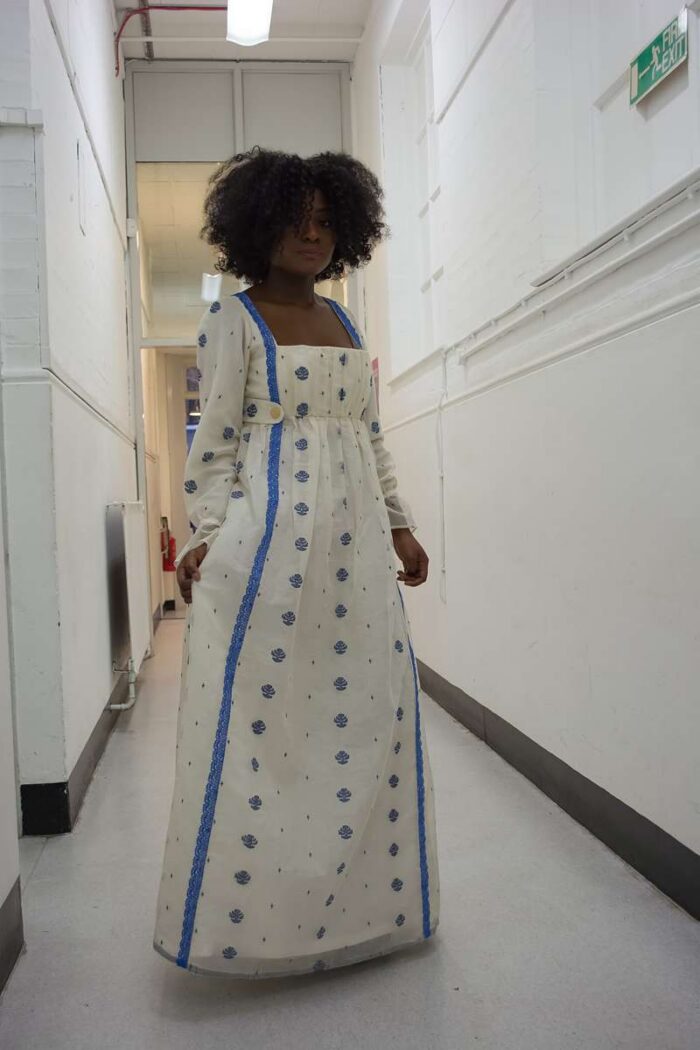
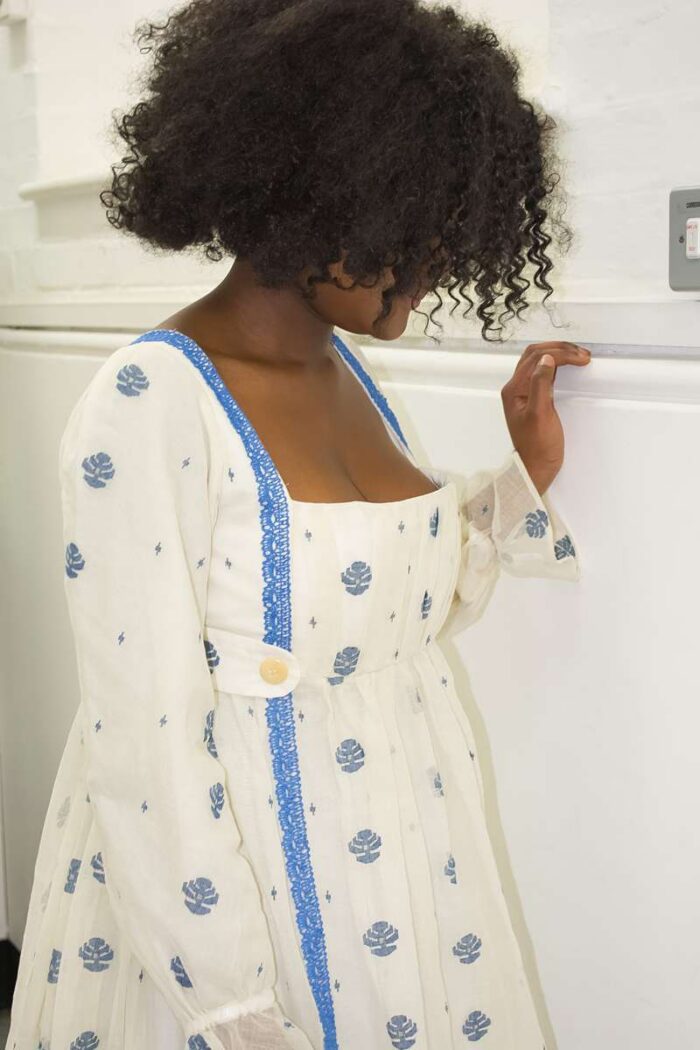
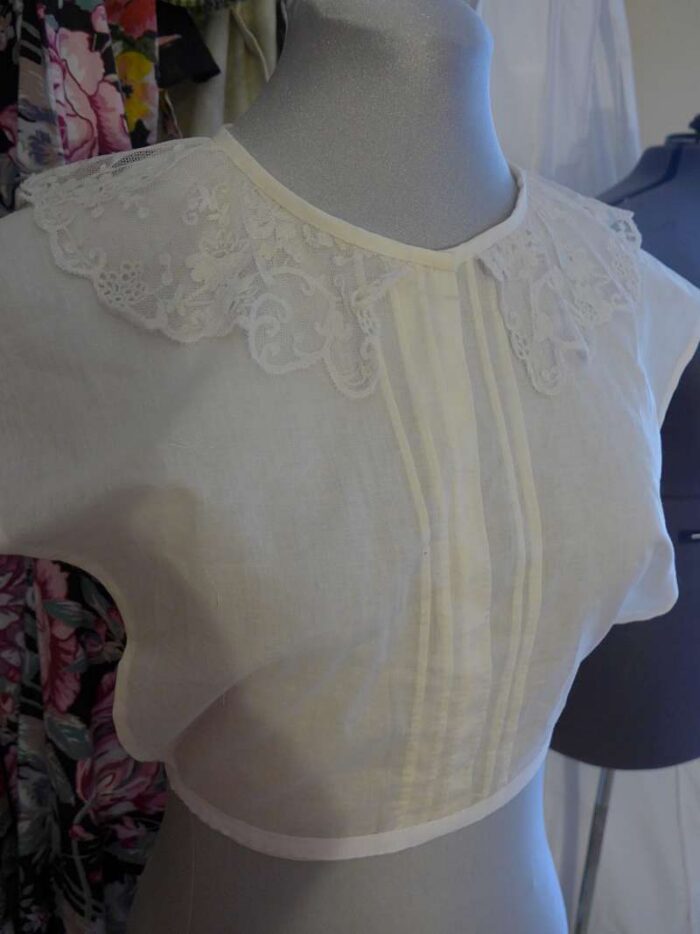
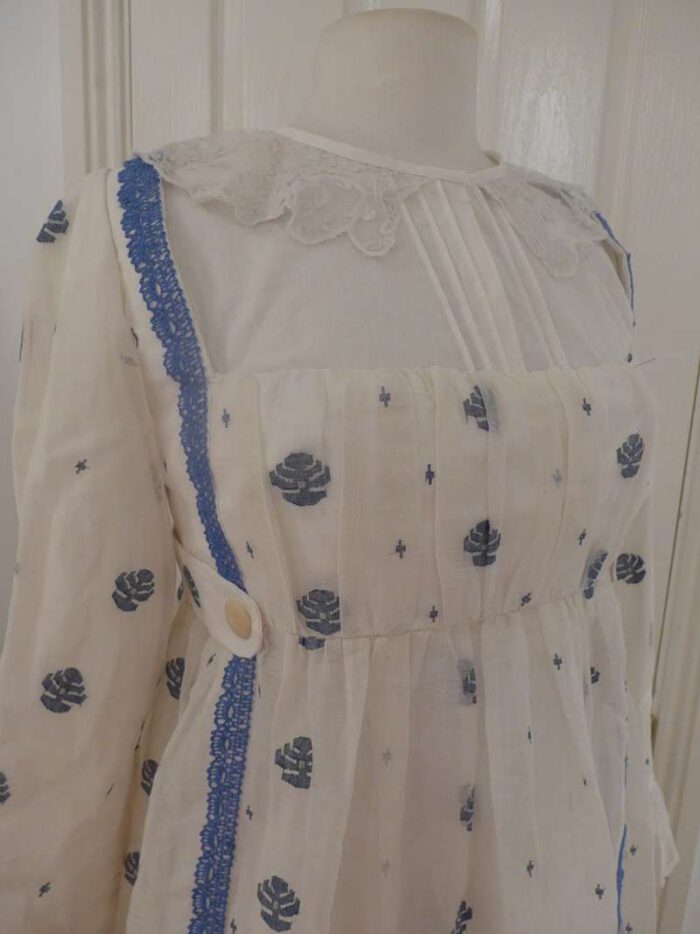
We also made a ‘chemisette’ which an historical modesty garment, like part of a blouse. Fashion dictated low, exposing necklines but this was not always comfortable, practical or flattering to women. Various methods of providing coverage were used. A Chemisette is just the front and collar of a blouse with tapes to fasten. It is tucked into the open, low necklines of day garments to make then more modest (and warmer).
The Muslin and silk evening dress 1815
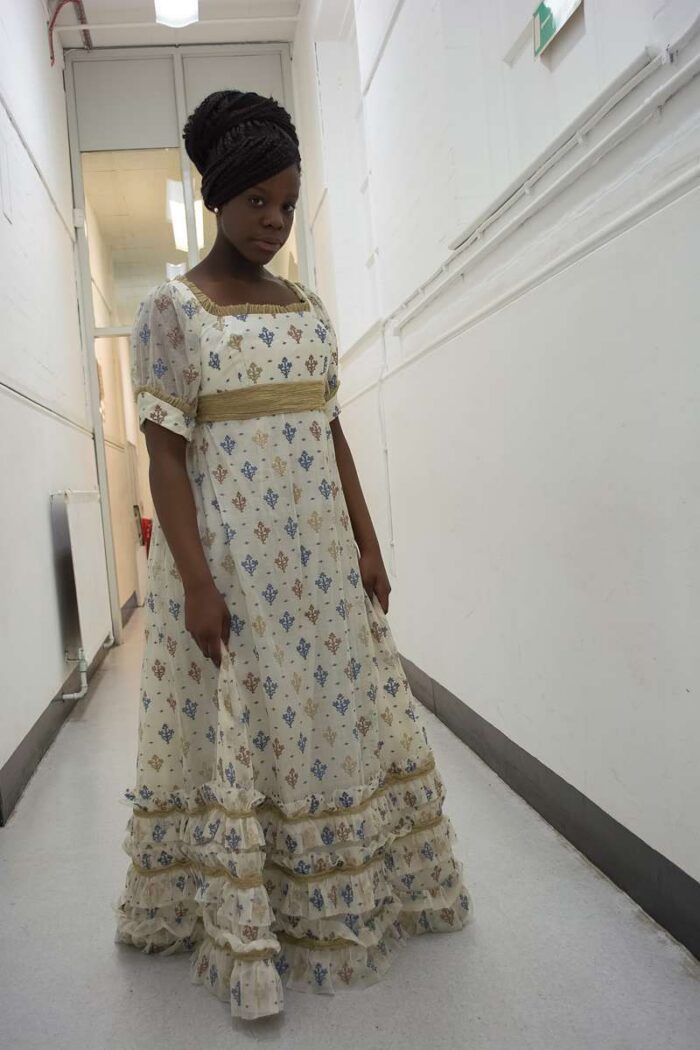
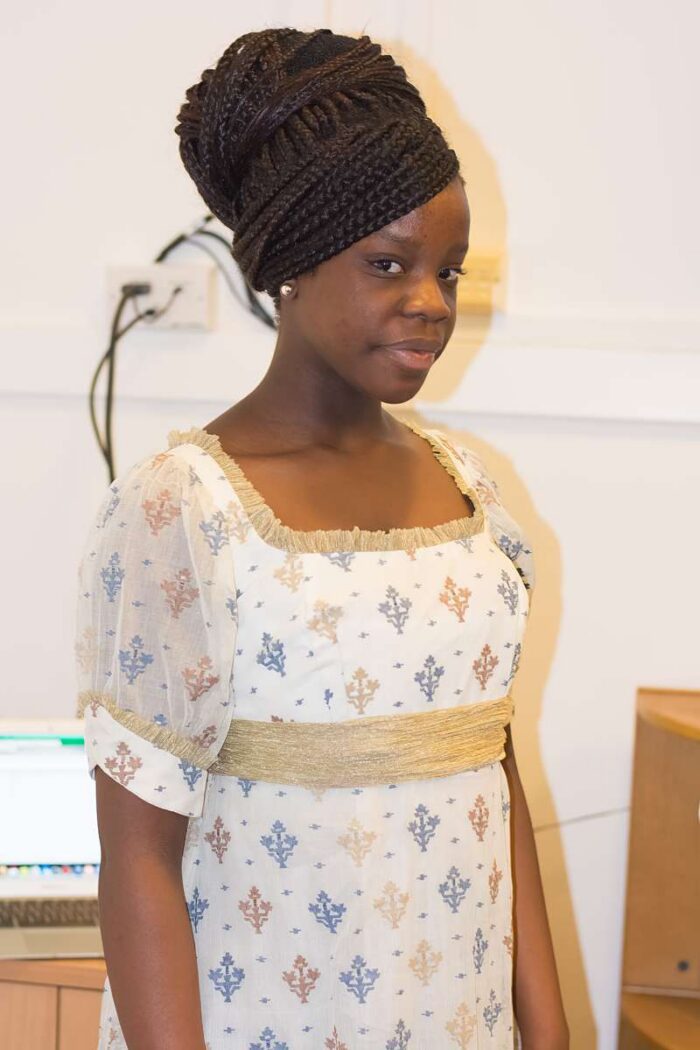
The evening dress featured extra fabric as well as the Jamdani muslin. We bought the gold crushed organza from Bennett silks. We used it to trim the dress along the neckline, sleeve cuffs, waistline and around the hem flounces.


The three lines of gathered frills along the hem of this dress were not hemmed. As was common during this period the fabric was simply cut and left unfinished. Specially shaped scissors called ‘pinking sheers’ create a zig-zag edge to the cut strips. This shaped cut, combined with the natural properties of the traditionally produced cotton yarn and weaving process mean the fabric is not liable to fray much.
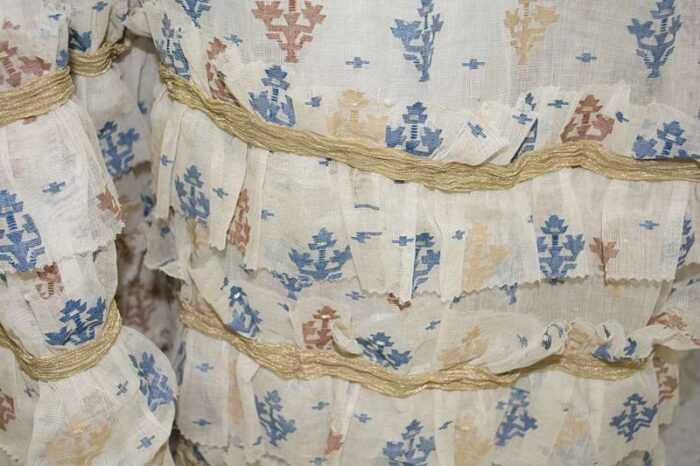
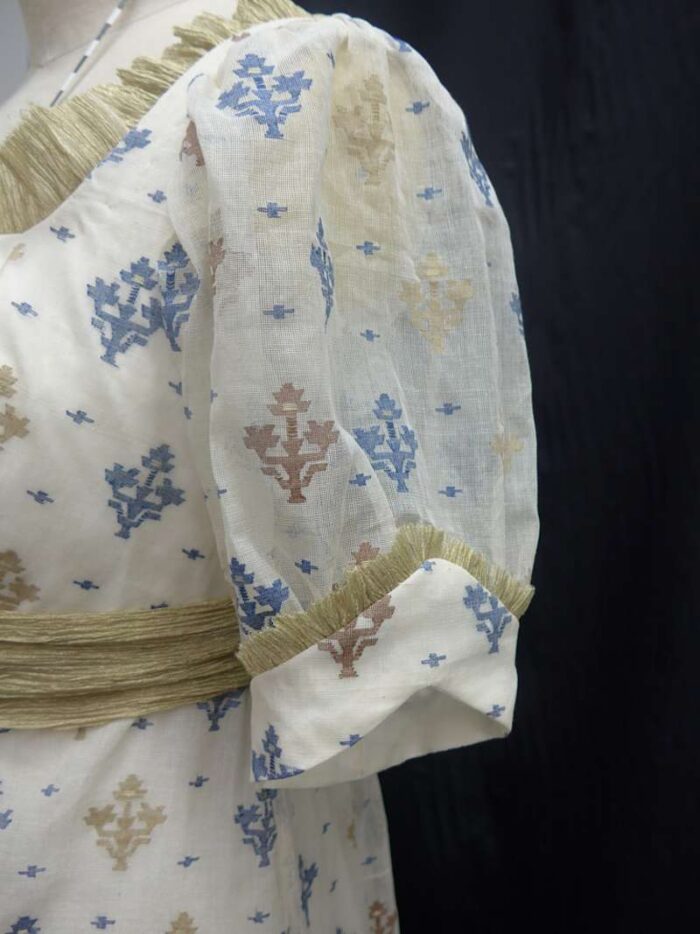
One of my favourite elements of the evening dress was the shaped sleeve cuff. The design shape was directly copied from a real Regency dress. The bodice and sleeve cuffs on the evening dress were faced/lined with cream cotton lawn. The skirt and sleeves were left unlined.
Boned Petticoat
The students also made foundation and support layers for each dress. This included two petticoats with boned bust sections and a bum-roll for the day dress.
Ideally we might have made Regency ‘stays’ (corsets) but were was limits on our available time and resources. By combining the bust support needed for the styles of the empire line dresses into the petticoats we ensured the silhouette was correct and that the sheer dresses were suitably lined for our younger models to wear. In fact the evening dress could have been worn unlined, without the petticoat and appeared period accurate as some more daring oyng ladies in the Regency era did wear their muslin dresses as see-through garments.

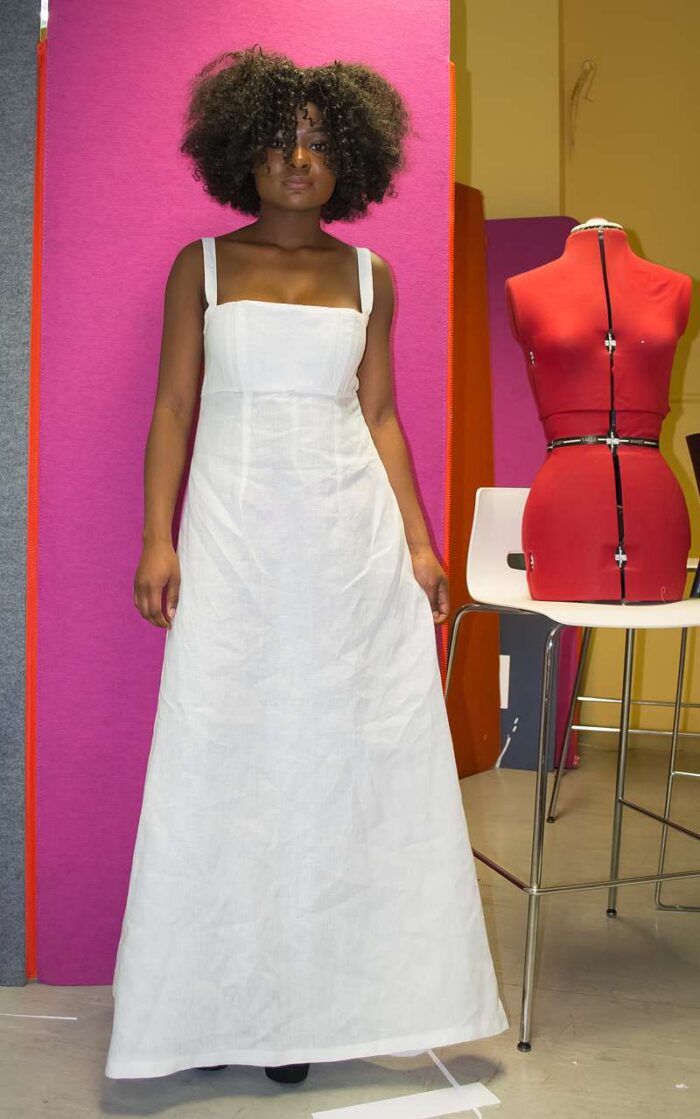
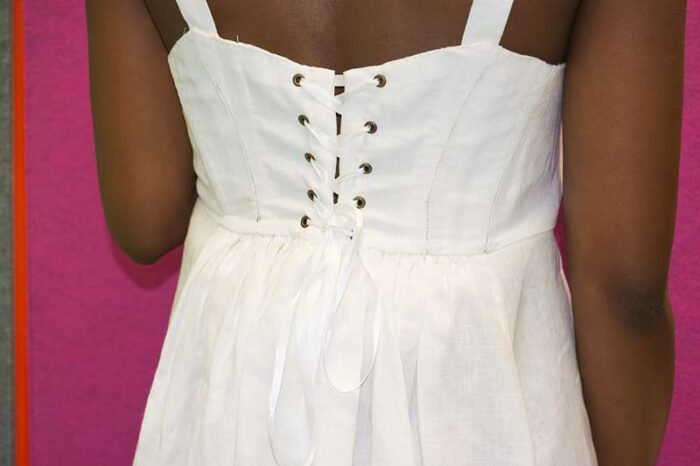
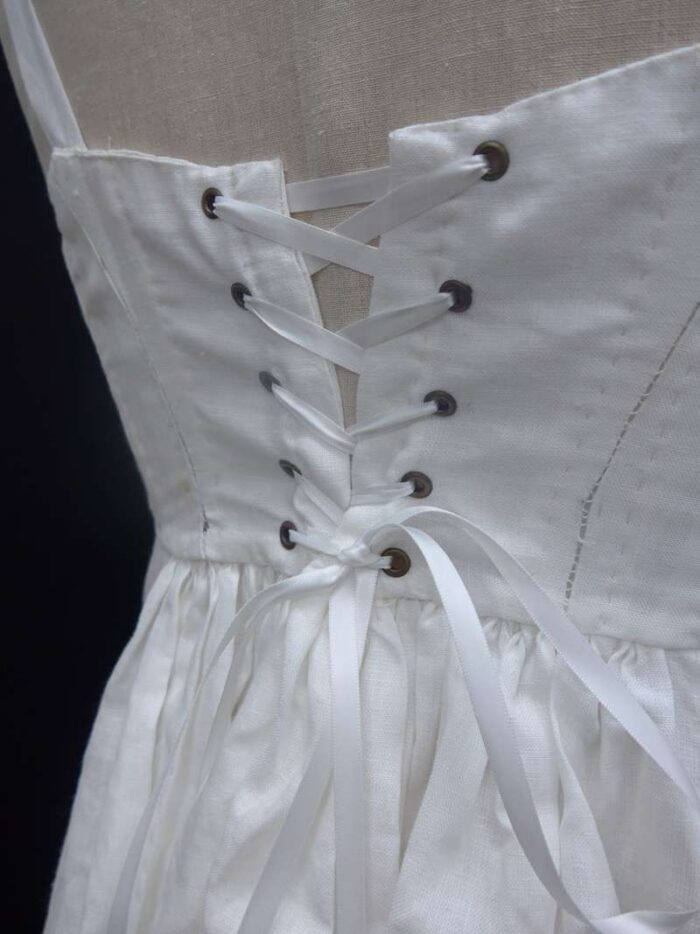
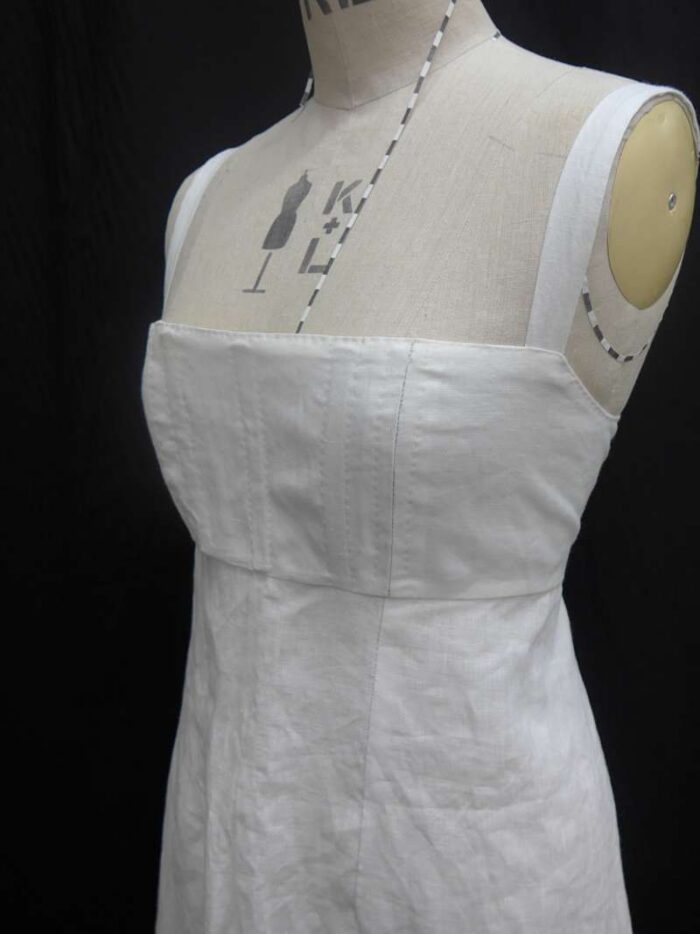
The petticoats were made of linen and fastened with eyelets and lace-up ribbon.
Presentation of the finished dresses
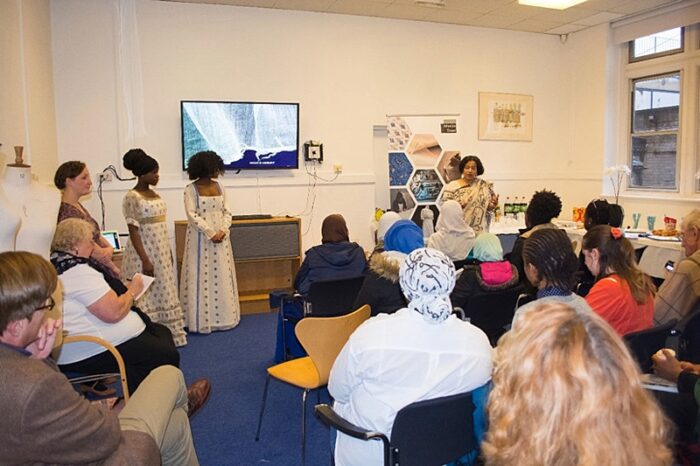
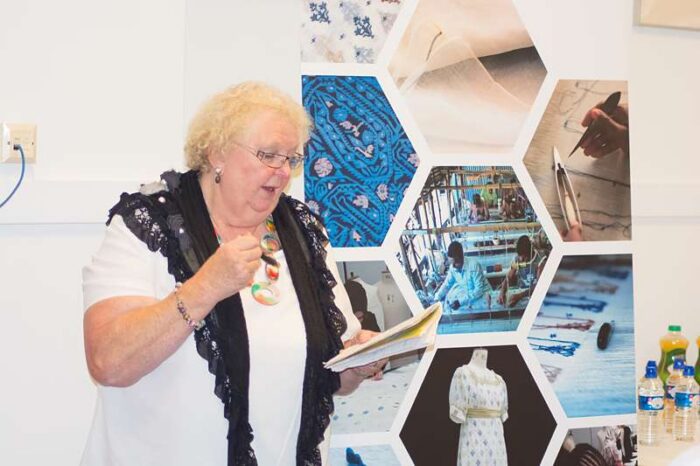
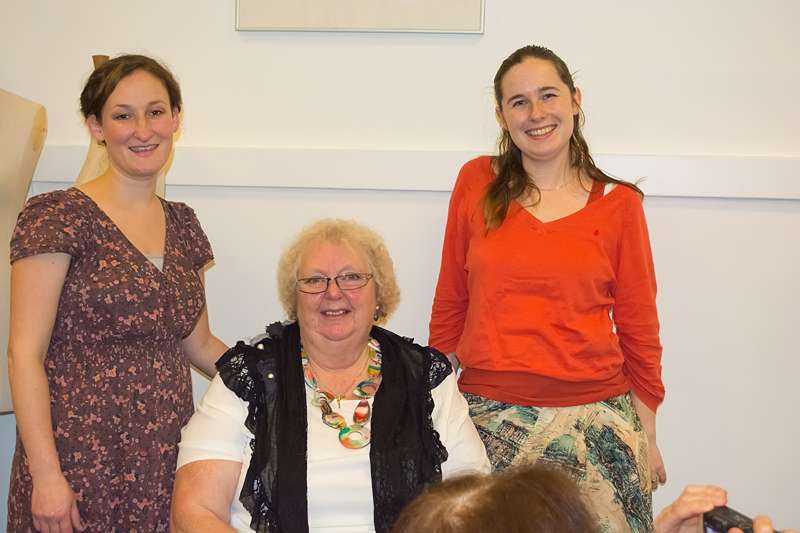
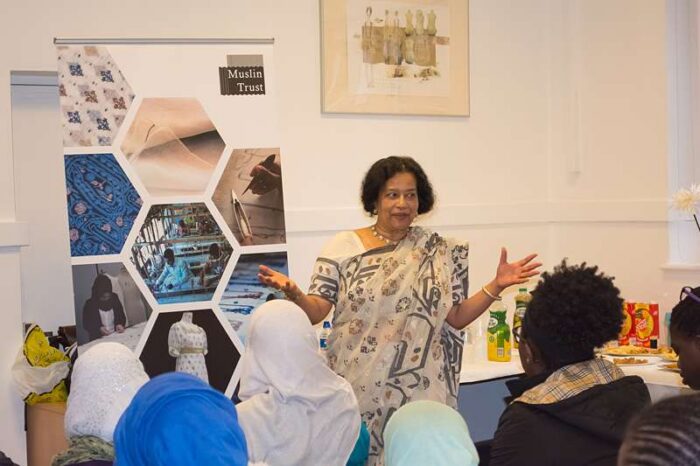
There was a party and presentation at the end of the course. Two students modelled the finished dresses and the tutors talked about how they had been made. There were Bengali snacks and performances of Bengali music. Rifat Wahhab chair of The Muslin Trust gave a presentation on muslin and how the charity was beniftiing the weavers in Bangladesh.
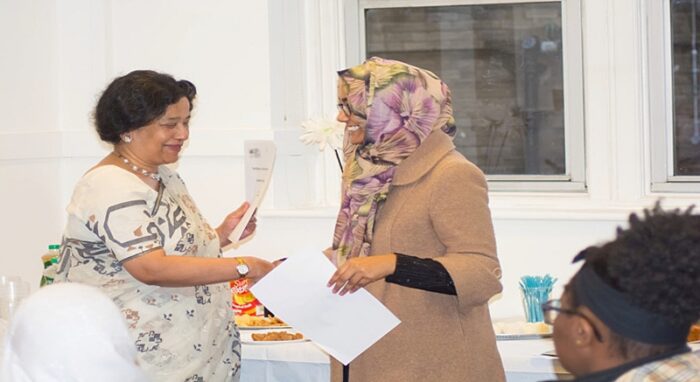
Certificates were given out to each student who had participated. Feedback from the students included comments on being delighted to receive my their own sewing kits and working with different ages in a studio. Another student said he particularly enjoyed learning how to do back-stitch.
The project has provided an opportunity for young people to learn about the skills involved in historical sewing techniques and working with Jamdani. Participating in the project has helped them acquire transferable skills and improve their chances of future employment in their chosen fields. They have also enhanced their learning portfolios, which will assist with their entry into higher education in the longer term.
Acknowledgements
Photography by Nurun Nahar Nargis, Muhammed Ahmedullah and Dominic Chevidan.
The Jamdani Project has been made possible by the efforts of the following people:
Project participants: Sabrina Begum, Humaydah Fabiha, Tayeb Grace, Sara Hilmi, Kai Johnson, Rumali Khan, Gloria Massamba-Lutama, Sindy Nguyen, Sonia Obasogie.
Tutors: Eleanor Bell, Elizabeth Callow, Felicity Westmacott.
The Muslin Trust, Rifat Wahhab (Chair), Dr Sonia Ashmore, Dr Lipi Begum, Ruby Ghuznavi, Sabina Khan, Saif Osmani, Bruce Sheppy.
Special thanks to: Drik (Bangladesh), Carole Morrison (Outreach Manager, LCF) and Sheron Williams (Technician, LCF).
Additional Reading
Ashmore, S. (2012) Muslin. London: V&A Publishing.
Bassett, L.Z. (2001) Textiles for clothing of the early republic, 1800-1850: a workbook of swatches and information. Arlington, Va: Q Graphics Production.
Bhatnagar, P. (no date) Sari-Tangail and Jamdani. Available at: http://www.academia.edu/373055/Sari-Tangil_and_Jamdani (Accessed: 11 December 2015).
East End Life (2015) ‘New project from Bengali east end heritage society’, (1087), 23-29 November, p. 19. Available at: http://ebook-tm.s3.amazonaws.com/East_End_Life_23Nov2015/index.html#/1/ (Accessed: 17 November 2015).
Kennedy, R. (ed.) (2002) The silk road: connecting cultures, creating trust, Smithsonian Folklife Festival held at the Smithsonian Institute, Washington (USA) 2002 [programme guide].
Stepney Community Trust (2013) How villages and towns in Bengal dressed London ladies in the 17th, 18th and early 19th centuries. Available from: http://www.stepney.org.uk/heritage-bengal-to-london-fashion.html (Accessed: 17 December 2015).
Turner, D. (2015) ‘Young designers celebrate creating historic gowns’, Hackney Today (368), 30 November, p. 21. Available at: http://www.hackney.gov.uk/Assets/Documents/368.pdf (Accessed: 17 December 2015).